5 min read
AI Didn't Make Content Easier. It Made Prioritizing It Harder.

Share
AI has made it so easy to generate content that most companies think the hard part is over. It isn't. It just moved.
AI generated content often creates a new problem instead of solving the old one: too much "good" content with no clear priority. Websites end up cluttered because every idea seems worth including. The real work now is organizing, cutting, and building a hierarchy that tells visitors what matters first, not generating more words.
We use AI constantly in the early stages of a website project. Strategy, discovery, first-pass wireframes, all of it moves faster now. That part isn't in question. What's changed is what happens after the content exists.
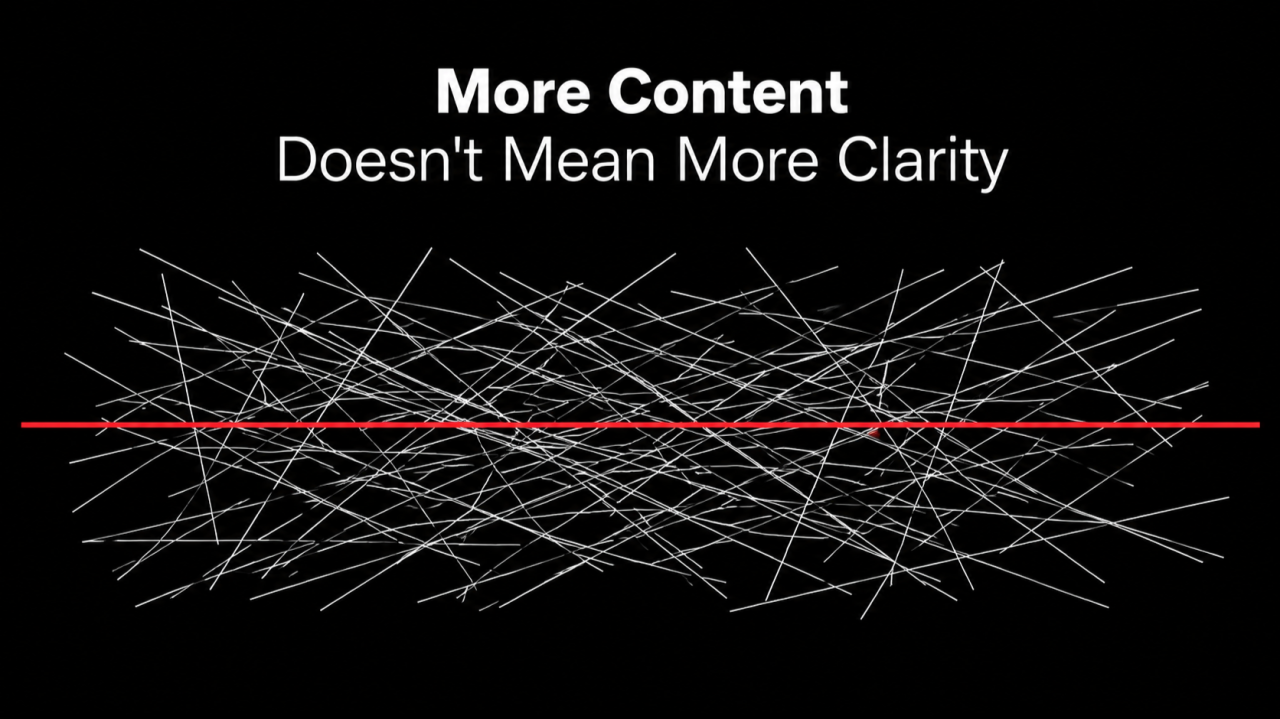
More Content Doesn't Mean More Clarity
Here's what we keep running into. AI gives you so much volume that it becomes overwhelming almost immediately. You go from staring at a blank page to drowning in options, and every one of those options is technically fine. Nothing is obviously wrong. But nothing is obviously right either.
That's the trap. When everything is "good," teams lose the instinct to say no. They start throwing all of it at the website because cutting anything feels like a loss. The result is a homepage that tries to say ten things at once, and a visitor who leaves without understanding any of them.
More content was supposed to solve the clarity problem. Instead, it's usually the thing causing it.
The Bottleneck Moved, It Didn't Disappear
For years, the hard part of a website project was writing the content. Getting a founder to articulate what the company actually does, finding language that didn't sound like everyone else's, that took real work and real time.
AI collapsed that timeline. What used to take weeks of drafts and feedback now takes an afternoon. But collapsing the writing timeline exposed a different skill that was always necessary and never had a name: knowing what to leave out.
That skill doesn't come from a prompt. It comes from understanding the business well enough to know which idea actually matters most to the person reading the page, and which ideas, however true, are just noise competing for the same attention.
Organizing Content Is a Strategy Problem, Not a Writing Problem
This is the part most teams skip. They treat the pile of AI generated content as a finished product instead of raw material. So they publish most of it, or worse, they let their designer figure out the hierarchy by feel while building the page in Figma.
Design can't fix a prioritization problem. If you hand a designer fifteen equally weighted points and ask for a clear page, you're asking them to make a strategic call they were never equipped to make. That's not a design failure. It's a sequencing failure.
Once the hierarchy is actually decided, once you know what needs to be said first, second, and third, design gets easy. Whether that's happening in Figma or inside a tool like Claude, the designer isn't guessing anymore. They're executing a decision that's already been made.
What This Means for Your Website
If you're sitting on a stack of AI generated content and the site still doesn't feel clear, the content probably isn't the problem. The order is. Somewhere in that pile is the one thing your ideal visitor actually needs to hear first, and right now it's competing with nine other things for the same real estate.
Finding that one thing, and being willing to cut or demote everything else, is the actual work now. It's less glamorous than generating content, and it's the part that actually determines whether your site converts.
Frequently Asked Questions
Why does my website feel cluttered even though the content is well written? Well-written content can still lack hierarchy. If every section is treated as equally important, visitors have no clear path to follow and end up unsure what the company actually does or why it matters to them.
Can AI help with organizing content, not just generating it? AI can support the process, but prioritization requires judgment about the business and the audience that a prompt alone can't supply. It's a strategic decision, not a formatting task.
Should I cut content that's technically good but not essential? Yes. Good content that doesn't support the main message dilutes the page. Cutting it is usually what makes the content that remains actually work.
Is this a design problem or a content problem? It's a content and strategy problem that shows up as a design problem. Fixing it in design without fixing the hierarchy first just makes the confusion look nicer.
Where This Leaves You
AI didn't eliminate the hard part of building a website. It just relocated it from writing to deciding. If you're sitting on a pile of AI generated content and can't tell what actually deserves the top of the page, that's worth a conversation. Happy to take a look and talk through how we'd organize it.
Related Blogs
Lorem ipsum dolor sit amet, consectetur adipiscing elit, sed do eiusmod tempor incididunt ut labore et dolore magna aliqua. Ut enim ad minim veniam, quis nostru.

Why Madak Uses Figma
The cloud-based design tool, Figma, enables collaboration and group sharing so everyone has access to important projects. Figma is a go-to tool for Madak, as it provides a multitude of features that make website creation and interface design more productive. It also helps different team members stay on the same page no matter where they’re working from! Keep reading to learn about some of the biggest reasons Madak uses Figma and to get insight into how this tool can empower your own team.
.webp)
How to Generate More Leads with YouTube
Since its creation in 2005, more people have visited YouTube than almost any other site on the Internet. YouTube comes in just behind Google for most web traffic in the world, and users watch over 1 billion hours of content every day. The age, identity, and geographic location of YouTube’s viewer base are extremely varied, so it is a prime place to market and produce content about your business. With YouTube, the possibilities are endless when it comes to spreading the word about what you and your business can offer consumers. Keep reading to learn how to generate more leads with this famous video platform!

Why Madak Uses Email Automation
Sometimes sending a mass email can feel like sending a message into a dark void, hoping someone is there to hear it on the other side. Without the right tools, it’s difficult to know how many people are actually engaging with your emails, not to mention who is engaging with your emails. This is why Madak uses HubSpot email automation to craft well-written emails and keep track of how our marketing content is reaching our audience. Continue reading to learn about the benefits of using email automation and how Madak can help you set up your very own email automation with the help of HubSpot.
Reimagine Your Digital Impact
Transform your website, pitch decks, sales collateral and more, all with transparent, upfront, pricing.