5 min read
Design Thinking

Share
How do marketers, product designers, business strategists, and everyone else in your organization make decisions? There are a lot of different ways to come up with product ideas, generate marketing campaigns, and make executive business-altering decisions.
Perhaps you use mountains of data to make the most statistically informed choices, or maybe you gather customer feedback and get advice right from the source. Though these methods have their merits, they can be drastically improved when you implement design thinking.
Defining Design Thinking
Design thinking is closely related to product development and innovation. As opposed to creating a product or making business decisions based purely on hard data and surface-level characteristics, design thinking allows you to take your customers’ desires into account as well as your purpose as an organization.
As a customer-centric model of innovation, design thinking puts the customer at the forefront of the discussion and helps you consider what their needs are and how you can meet them while staying within the capabilities of your business. In other words, design thinking involves considering people’s everyday behaviors, thoughts, motivations, desires, interactions with existing products and services, and more. When you dive into your customer’s life in this way, it becomes much easier to design a product with purpose.
The design thinking model benefits both your customers and your business. The people that buy from you will benefit from a more effective and fulfilling product, and your business will make more sales, waste less time on ideas that won’t succeed, and stay more relevant and well-regarded in general.
The Five Phases of Design Thinking
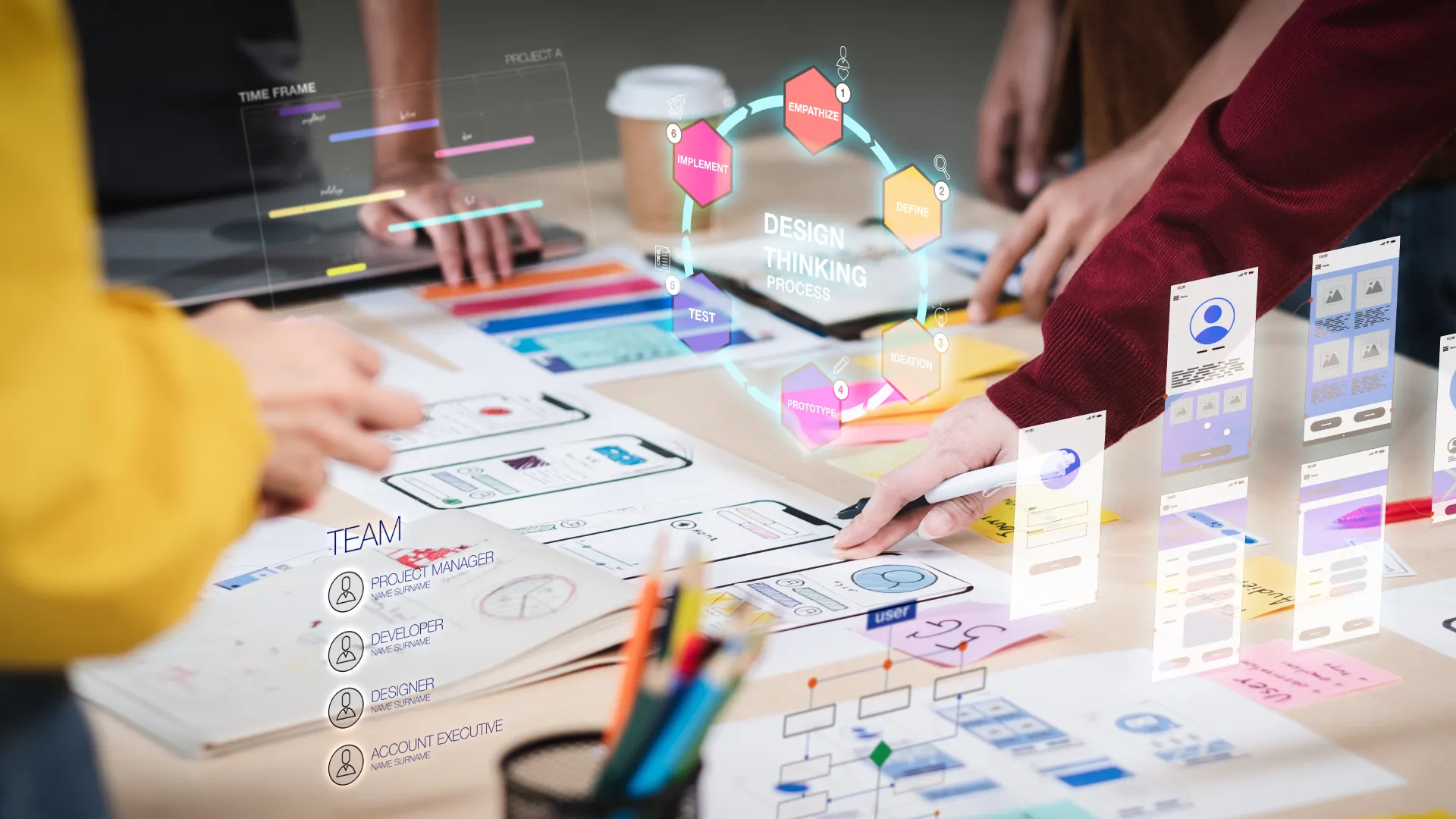
This innovative and customer-oriented method of development and design is often separated into five phases that promote immersion, ideation, and implementation:
Empathize With Customers
Before you and your team go to the brainstorming board, you must put yourself in the shoes of your customers to get a better understanding of their everyday challenges and their pain points.
Define Their Problems
What issues are your customers experiencing, and why? Which of these issues or pain points is the most disruptive to them? Why are the solutions they currently have not good enough?
Ideate: Come Up With Better Solutions
Brainstorm and design better solutions to your customer’s problems. You can never have too many ideas for products. Narrow down the best solutions by imagining yourself in your audience’s place and considering what the ideal customer experience would be.
Turn the Best Ideas Into Prototypes
Ideas have to become a reality to make an impact. After considering which solutions are actually feasible for you to make with the resources available to you, create a variety of prototypes that can be tested by your team and your customers.
The Testing Phase
Allow people to put your product in action and then ask for their feedback. Have planned out metrics to measure the relative success or failure of a finished product. Make sure to gather opinions from the people that matter most when releasing a new product: your customers.
How Design Thinking Supports Your Success
With such a big focus on innovation in today’s markets, many businesses struggle to develop successful products and implement beneficial business strategies. Design thinking helps increase creativity and empathy and leads to happier customers and businesses with higher profits.
It is much more productive to mold your business and its offerings to what the customer wants and needs rather than basing decisions off of impersonal metrics and hoping that they are received well. This doesn’t only apply to the creation of products either一design thinking can help you narrow down your priorities in many different situations.
For example, you might have several different customer-related goals on your to-do list and are unsure which one should be your primary concern. When you use design thinking to put yourself in the customer’s position, it will be easier to make a decision about priority levels. Ex: you decide to improve your customer service to ensure lifelong loyalty instead of releasing a new product in the midst of a customer experience crisis.
The Bottom Line...
At its core, design thinking is a methodology that promotes human-centered thinking in business. From product design and innovation to marketing and customer service, design thinking can help you make the most effective and beneficial decisions for your business.
Related Blogs
Lorem ipsum dolor sit amet, consectetur adipiscing elit, sed do eiusmod tempor incididunt ut labore et dolore magna aliqua. Ut enim ad minim veniam, quis nostru.

9 Call to Action Best Practices
When determining the best marketing strategy for your business, it is essential that you take a close look at your calls to action. The call to action, or CTA, could be considered the most important part of your copy. It is the part that motivates potential customers to take action (buy, sign up, visit a page, etc.) while providing them with the necessary steps for what to do next. For this reason, creating a powerful and memorable CTA for your web copy and sales copy is vital to your company’s overall success. Keep reading to learn more about CTA best practices that will improve your marketing strategy and help you convert leads more effectively.

Landing Pages vs. Websites
The core differences between landing pages and websites can be hard to figure out, especially if you are new to the world of digital marketing. Landing pages and websites play off one another and work together to form a cohesive brand and build trust and interest in your customers and leads. Though there are similarities between landing pages and websites, the two have some important distinctions that boil down to their purpose. Keep reading to learn about some of the differences and similarities between landing pages and websites before you take the plunge and start creating your own (or before your hire someone else to help you)!

What Is Story Marketing & Why Does It Matter?
People generally dislike advertisements. They resent feeling bombarded by ads as they go about their daily lives, and according to survey results reported by HubSpot, 91% of consumers say this intrusive feeling has gotten worse in the past several years. That’s why many experts claim that the future of marketing lies in storytelling. This article will talk about what story marketing is, why it’s predicted to be the next big thing in the digital marketing industry, and what makes it an effective strategy. Along with that, we will provide you with some tips on how you can incorporate storytelling into your own advertising efforts in order to make them more successful. Let’s get started!
Reimagine Your Digital Impact
Transform your website, pitch decks, sales collateral and more, all with transparent, upfront, pricing.