5 min read
Design Thinking

Share
How do marketers, product designers, business strategists, and everyone else in your organization make decisions? There are a lot of different ways to come up with product ideas, generate marketing campaigns, and make executive business-altering decisions.
Perhaps you use mountains of data to make the most statistically informed choices, or maybe you gather customer feedback and get advice right from the source. Though these methods have their merits, they can be drastically improved when you implement design thinking.
Defining Design Thinking
Design thinking is closely related to product development and innovation. As opposed to creating a product or making business decisions based purely on hard data and surface-level characteristics, design thinking allows you to take your customers’ desires into account as well as your purpose as an organization.
As a customer-centric model of innovation, design thinking puts the customer at the forefront of the discussion and helps you consider what their needs are and how you can meet them while staying within the capabilities of your business. In other words, design thinking involves considering people’s everyday behaviors, thoughts, motivations, desires, interactions with existing products and services, and more. When you dive into your customer’s life in this way, it becomes much easier to design a product with purpose.
The design thinking model benefits both your customers and your business. The people that buy from you will benefit from a more effective and fulfilling product, and your business will make more sales, waste less time on ideas that won’t succeed, and stay more relevant and well-regarded in general.
The Five Phases of Design Thinking
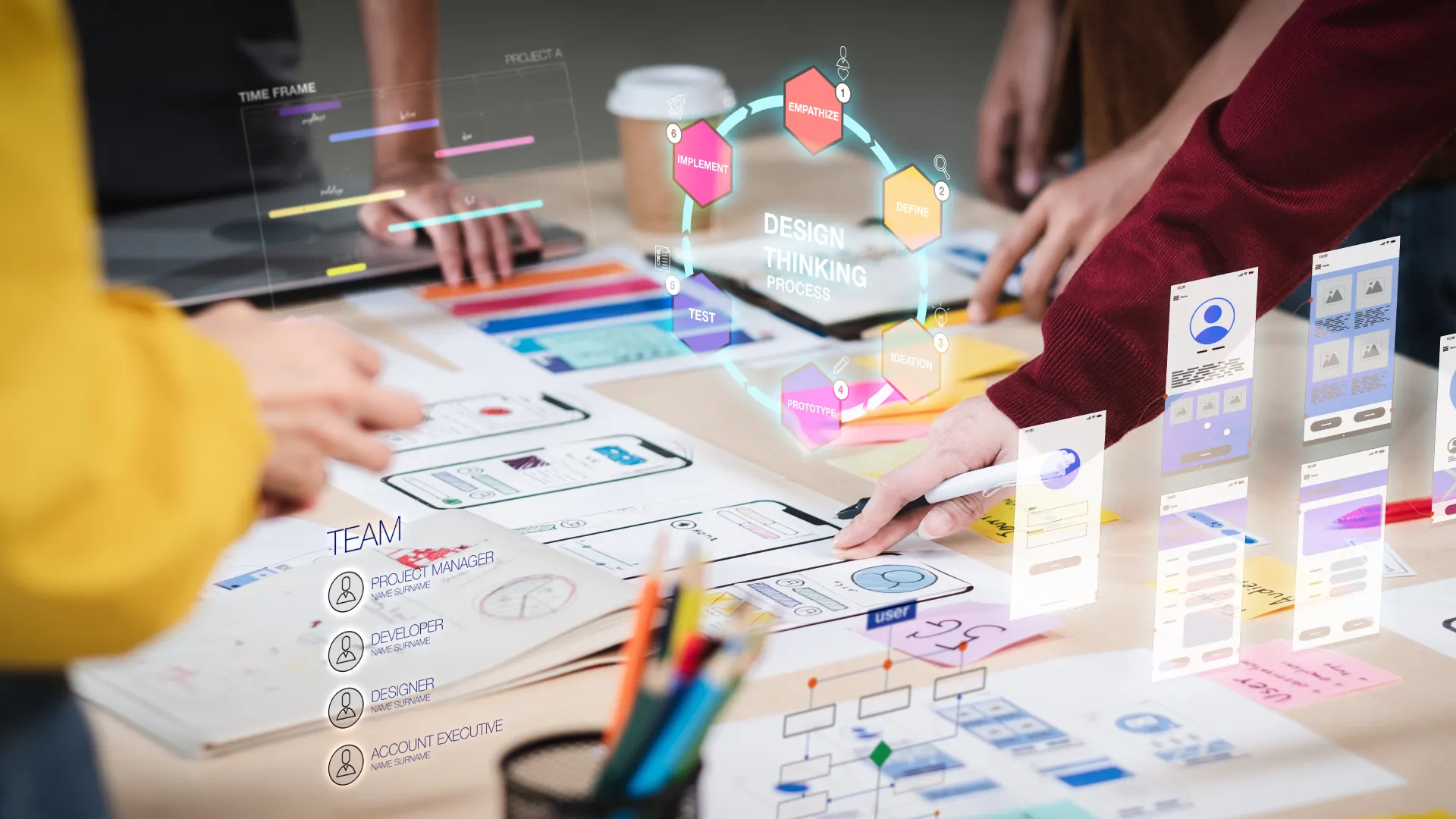
This innovative and customer-oriented method of development and design is often separated into five phases that promote immersion, ideation, and implementation:
Empathize With Customers
Before you and your team go to the brainstorming board, you must put yourself in the shoes of your customers to get a better understanding of their everyday challenges and their pain points.
Define Their Problems
What issues are your customers experiencing, and why? Which of these issues or pain points is the most disruptive to them? Why are the solutions they currently have not good enough?
Ideate: Come Up With Better Solutions
Brainstorm and design better solutions to your customer’s problems. You can never have too many ideas for products. Narrow down the best solutions by imagining yourself in your audience’s place and considering what the ideal customer experience would be.
Turn the Best Ideas Into Prototypes
Ideas have to become a reality to make an impact. After considering which solutions are actually feasible for you to make with the resources available to you, create a variety of prototypes that can be tested by your team and your customers.
The Testing Phase
Allow people to put your product in action and then ask for their feedback. Have planned out metrics to measure the relative success or failure of a finished product. Make sure to gather opinions from the people that matter most when releasing a new product: your customers.
How Design Thinking Supports Your Success
With such a big focus on innovation in today’s markets, many businesses struggle to develop successful products and implement beneficial business strategies. Design thinking helps increase creativity and empathy and leads to happier customers and businesses with higher profits.
It is much more productive to mold your business and its offerings to what the customer wants and needs rather than basing decisions off of impersonal metrics and hoping that they are received well. This doesn’t only apply to the creation of products either一design thinking can help you narrow down your priorities in many different situations.
For example, you might have several different customer-related goals on your to-do list and are unsure which one should be your primary concern. When you use design thinking to put yourself in the customer’s position, it will be easier to make a decision about priority levels. Ex: you decide to improve your customer service to ensure lifelong loyalty instead of releasing a new product in the midst of a customer experience crisis.
The Bottom Line...
At its core, design thinking is a methodology that promotes human-centered thinking in business. From product design and innovation to marketing and customer service, design thinking can help you make the most effective and beneficial decisions for your business.
Related Blogs
Lorem ipsum dolor sit amet, consectetur adipiscing elit, sed do eiusmod tempor incididunt ut labore et dolore magna aliqua. Ut enim ad minim veniam, quis nostru.
6 Reasons Why LinkedIn Is Important to Grow Your Business
Many business owners and marketers tend to overlook LinkedIn because it’s not a mega-popular social media platform such as Instagram or TikTok. However, LinkedIn is a very popular professional networking site that has many parallels to “traditional” social media channels. LinkedIn is a semi-casual platform where business professionals can discuss news, talk about jobs, share articles, evaluate new research, and much more. Its main focus revolves around networking and creating relationships based on career similarities and mutual business interests. That being said, LinkedIn grew into something bigger over the years, and nowadays, there are plenty of other benefits to using it for your company’s growth. Keep reading to learn about six reasons why you might want to prioritize LinkedIn in your growth strategy.

5 Tips On Providing Value to Your Customers
If you want to grow your brand, then creating strong ties with your target audience is essential. Gaining the trust and loyalty of your customers is a must for any modern company that wants to develop a solid customer base and continue to grow in its industry. Nurturing brand loyalty is about more than just producing high-quality products and services—it’s also about displaying credibility and sincerity and providing value in a multitude of ways. There are so many ways to offer value to your customers beyond the products and services you offer, and this value can tip the scale in your favor. In this blog, we will be taking a look at five actions you can take to provide great value to your customers. Let’s get started!

Most Frequently Asked Marketing Questions Answered
With the rise of the digital age, the marketing industry has gotten even more complex—sometimes, it feels like a massive puzzle that needs to be solved. No matter the size of your business or the extent of your marketing experience, a few questions are likely at the forefront of your mind at all times. Keep reading to get the answers.
Reimagine Your Digital Impact
Transform your website, pitch decks, sales collateral and more, all with transparent, upfront, pricing.