5 min read
Does Your Sales Deck Match Your Website? Why Brand Consistency in Sales Materials Builds Trust

Share
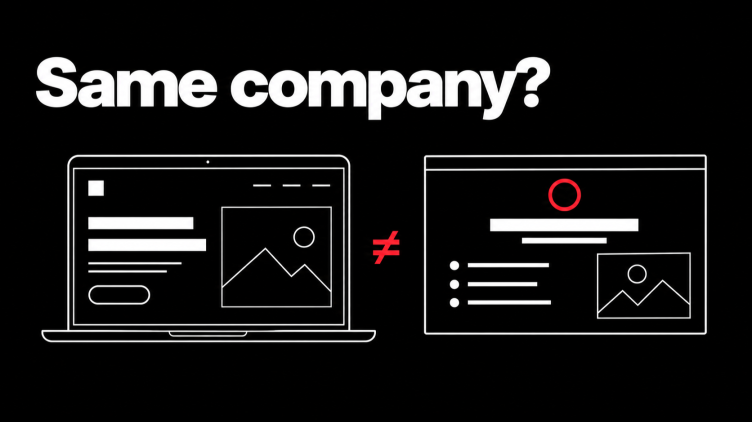
Here's a quick test. Open your website, then open the last deck your sales team sent to a prospect, and ask yourself whether they look like they came from the same company. For most teams we talk to, the honest answer is no, and that gap is quietly costing them trust at the exact moment they need it most. Brand consistency in sales materials doesn't get much attention, but buyers notice when it's missing.
Why should your sales deck match your website? Your sales deck should match your website because buyers compare them. When the visuals, language, and story line up, the company feels established and trustworthy. When they don't, buyers have to reconcile two different versions of you, and that friction slows decisions, raises doubts, and makes your team work harder to close.
How the Gap Between Your Website and Sales Deck Happens
Nobody sets out to build mismatched materials. It usually happens the same way at almost every company we've worked with. The website gets a proper refresh, with real strategy, updated messaging, and a design system behind it. Then, months later, a big pitch comes up and someone builds a deck in a rush.
That deck borrows an old template, pulls in a few slides from last year, and uses whatever case study language was lying around. It gets the job done for that one meeting. Then it becomes the deck everyone uses, and the next case study gets built on top of it, and so on.
Nobody made a bad decision along the way. The problem is that the website and the sales collateral were built in separate moments, by different people, under different pressures. Over time, you end up with two companies: the one on your site and the one in your sales team's inbox.
Why Buyers Notice (Even When They Don't Say It)
Buyers today do a lot of their homework before they ever talk to you. They've usually spent time on your website before the first call. So when your deck shows up with different colors, a different tone, and a slightly different description of what you do, they register it, even if they never mention it.
That mismatch creates a small but real question in their mind. Which version is accurate? Is this company as buttoned-up as its website suggests? Did the positioning change, or is the sales team pitching something else? None of these questions are fatal on their own, but each one adds a bit of work for the buyer, and trust is harder to earn when people have to work for it.
This is especially true in longer B2B sales cycles, where your deck gets forwarded to people who weren't on the call. That CFO or board member may see your website and your deck side by side without anyone there to explain the difference. The materials have to carry the story on their own.
Consistent Brand Messaging Is More Than Matching Colors
It's tempting to treat this as a design cleanup job: swap in the new fonts, update the logo, and call it done. Design matters here, because it's what earns attention and signals that you've got your act together. But consistency that actually builds trust goes deeper than the visual layer.
The real question is whether your website, deck, case studies, and leave-behinds all tell one story. Do they describe the problem you solve in the same words? Do they position you against the same alternatives? Does the proof in your case studies support the promise on your homepage? When the messaging and the design are working together across every piece, buyers get a clear, repeated signal about who you are.
That repetition is what makes a brand feel solid. A prospect who hears the same story on your site, in your pitch, and in the one-pager they take back to their team walks away with a much clearer picture than one who hears three slightly different versions.
Build Sales Collateral in the Same System as Your Website
The fix we recommend is simple to describe: build your decks, case studies, and leave-behinds in the same system as your website. That means the same messaging foundation, the same visual language, and the same story, planned together instead of patched together later.
At Madak, that's how we approach sales deck design. When we rebuild a website, we look at everything the sales team is sending out and bring it into the same system, so every piece reinforces the others instead of competing with them.
SafeTraces is a good example. They needed a sales deck and an investor deck that matched the brand and website we rebuilt for them, all as part of the same project. Because everything was built together, their prospects and their investors saw one consistent company no matter where they encountered it. Within a year, their leads were up 5x, and they closed the investment they were after.
How to Audit Your Own Sales Materials
You don't need an agency to see where you stand. Start with the test from the top of this post: put your homepage next to your most-used sales deck and look at them honestly. Then do the same with your newest case study and whatever one-pager your team leaves behind after meetings.
Look for differences in how you describe what you do, who you serve, and why you're different. Check whether the visual style feels like one family or a collection of cousins. Pay attention to anything outdated, like old service names, retired logos, or positioning you've moved away from.
If you find gaps, that's normal. The goal isn't to feel bad about it. It's to decide which version of your company is the right one, and then bring everything else in line with it.
Frequently Asked Questions
Q: Why does brand consistency in sales materials matter? A: Buyers compare your website and your sales materials, often without you in the room. When they match, your company feels credible and established. When they don't, buyers have to reconcile two versions of you, which adds friction and doubt to the decision.
Q: What sales collateral should match my website? A: At minimum, your sales deck, case studies, and any leave-behinds or one-pagers your team sends after meetings. If you're raising money, your investor deck belongs on that list too, since investors will almost certainly look at your site.
Q: Is updating my sales deck design enough to fix the problem? A: Updated design helps, but it's only half the job. The messaging needs to line up as well, so that every piece describes your problem, your solution, and your proof the same way. Design earns attention, and consistent messaging turns that attention into trust.
Q: How often should sales materials be updated? A: Any time your website messaging or positioning changes, your sales materials should change with it. The easiest way to manage that is to build everything in one system from the start, so updates happen together instead of drifting apart over time.
Q: How long does it take to align a sales deck with a website? A: It depends on how far apart they've drifted and how many pieces you're working with. The fastest path is usually to start with the deck your team uses most, since that's the piece buyers see most often.
One Company, One Story
Your buyers shouldn't have to figure out which version of your company is the real one. When your website, deck, and case studies all tell the same story, your sales team spends less time earning trust and more time moving deals forward.
If you'd like a second set of eyes on what you're sending out now, take 20 minutes with the Madak team and we'll walk through it with you.
Related Blogs
Lorem ipsum dolor sit amet, consectetur adipiscing elit, sed do eiusmod tempor incididunt ut labore et dolore magna aliqua. Ut enim ad minim veniam, quis nostru.

Reimagine Your Digital Impact
Transform your website, pitch decks, sales collateral and more, all with transparent, upfront, pricing.