5 min read
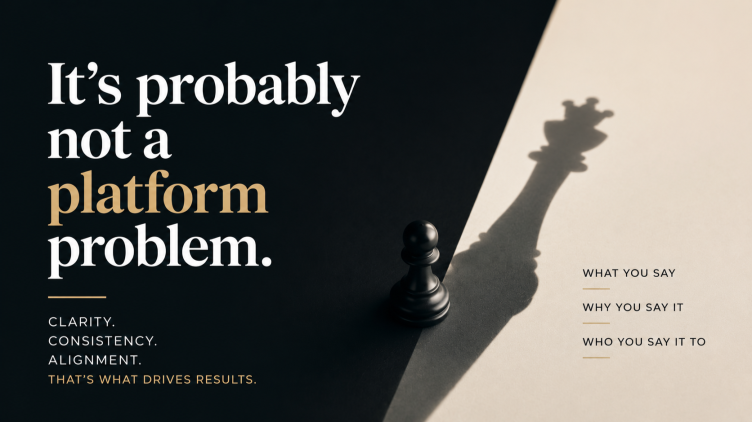
It's Probably Not a Platform Problem

Share
Being clear through your website and collateral is genuinely hard. Most teams think they need better design or more content, but the real problem is they haven’t figured out how to say what they do in a way that actually lands. Getting there usually takes more work than people expect. It’s a lot of back and forth, honest conversations, and cutting things down until what’s left finally feels simple and clear.
A lot of businesses avoid that part because it’s uncomfortable. It forces you to decide what actually matters, who you’re really trying to speak to, and what the company should be known for. But when that work doesn’t happen, you can feel it pretty quickly. Sales and marketing start pulling in different directions. The website says one thing, the deck says another, and internally everyone is explaining the business slightly differently depending on who they’re talking to.
That disconnect creates drag that’s hard to measure but easy to feel. Marketing starts generating activity without momentum. Sales conversations take longer than they should. Content becomes harder to create because nobody is fully aligned on the message behind it. Most businesses don’t actually have a platform problem. They have a consistency problem.
What usually drives results is alignment. Alignment between what you’re saying, why you’re saying it, and who you’re saying it to. When those things line up, everything gets easier. The website feels clearer. Sales conversations become more natural. Marketing starts compounding instead of constantly restarting.
The hard part is that this isn’t a one-time fix. Businesses evolve, priorities shift, and messaging needs to evolve with it. That ongoing refinement is usually the part most agencies don’t stick around for, even though it’s the part that matters most long term.
If your marketing feels like it’s working without really going anywhere, there’s usually a deeper reason behind it. Happy to take a look and share a few honest thoughts if it’s useful.
Related Blogs
Lorem ipsum dolor sit amet, consectetur adipiscing elit, sed do eiusmod tempor incididunt ut labore et dolore magna aliqua. Ut enim ad minim veniam, quis nostru.
.webp)
Creating an Engaging Website With UI/UX
If you’re looking to build a website that will keep your visitors engaged and coming back for more, then you need to focus on creating an immersive user experience. A great user interface (UI) and user experience (UX) are key to making sure that your audience has a positive interaction with your brand as they navigate through your digital space. However, while creating a seamless UI/UX can be incredibly rewarding once launch day arrives, it can also be overwhelming to figure out how exactly to get there in the first place. This week we’ll explore all aspects of designing an unbelievably functional UI/UX for any industry!
.webp)
Why Website Developers Use Figma
Website developers are constantly seeking efficient tools and platforms that streamline their workflows and enhance the overall design process. Figma has emerged as one of the leading collaborative design tools in recent years, and it has gained immense popularity among web developers for a multitude of reasons. Let’s dive into why Madak uses Figma to design and build our client’s websites before we develop them in Webflow!
Reimagine Your Digital Impact
Transform your website, pitch decks, sales collateral and more, all with transparent, upfront, pricing.