5 min read
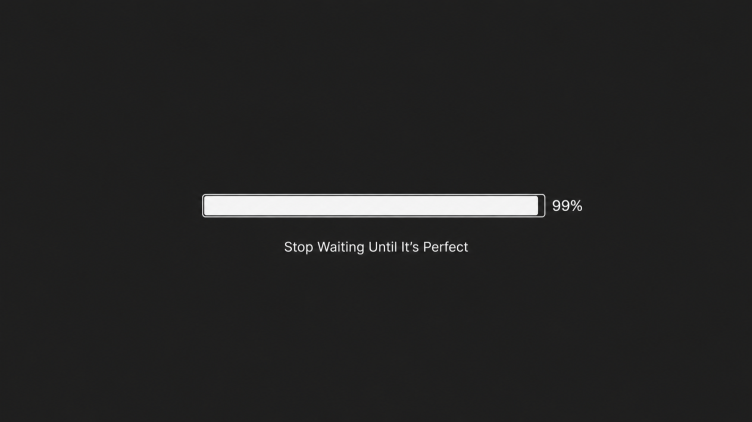
Stop Waiting Until It's Perfect

Share
There's a pattern most teams fall into without realizing it. The website gets one more round of revisions. The messaging gets reworked again. The launch date moves. And the longer it sits, the more precious it becomes, which makes it even harder to ship.
At some point, waiting stops being about quality and starts being about comfort.
The myth of the perfect launch
Most teams believe that if they just get it right before it goes out, the results will follow. So they refine. They workshop. They get more people in the room. They add more words, then cut them, then add them back. The process feels productive because there's always something to improve.
But there's a ceiling to what internal review can actually do for you. Your team is too close to it. They know what you mean even when the words don't quite land. They fill in the gaps automatically. Customers don't do that. They read exactly what's there, and they either get it or they don't.
No amount of internal iteration closes that gap. Only shipping does.
What holding back actually costs you
When teams delay, the conversations about what the company does and who it's for stay hypothetical. Everyone has a theory, but no one really knows how it lands in the real world. The messaging stays abstract. The website stays in a shared doc somewhere.
And the longer it sits, the more people get attached to the version they built in their heads rather than the one that actually needs to exist. Decisions get harder. Consensus gets messier. The thing takes on a weight it was never supposed to have.
Meanwhile, the feedback you actually need is sitting on the other side of publishing it.
What happens when you start moving
You will learn more in the first two weeks after something goes live than in the months you spent building it. Real people reacting in real time will tell you things no internal review ever could.
What confuses them. What resonates immediately. What questions they still have after reading your homepage. What they click on first. What makes them leave.
That's the real brief. That's the information that sharpens your messaging, tightens your positioning, and tells you where to focus next. You can't manufacture that feedback ahead of time. You can only earn it by putting something out there.
Clarity comes from contact, not preparation
There's a tendency to treat launching as the end of the process, the moment when everything has to be right. But it's actually the beginning. It's when the work starts telling you what it needs to be.
The teams that move faster don't do it because they're less careful. They do it because they understand that the market will teach them things they can't figure out on their own. They build, ship, listen, and adjust. That loop is what creates clarity over time, not more time spent before the loop even starts.
A final thought
If you've been sitting on a launch, a page, or a pitch and it doesn't quite feel ready, it might just need a push out the door. The version that ships and gets refined is always better than the version that never leaves the building.
Sometimes a fresh set of eyes is all it takes to get unstuck. If that would help, happy to take a look.
Related Blogs
Lorem ipsum dolor sit amet, consectetur adipiscing elit, sed do eiusmod tempor incididunt ut labore et dolore magna aliqua. Ut enim ad minim veniam, quis nostru.

Tactics: What Is SEO Marketing?
Search engines are undeniably some of the most useful tools of the modern-day, and tens of thousands of searches are conducted every second. In this digital age of business, having an online presence is essential, especially when you’re trying to build brand awareness and market yourself effectively. Thankfully, search engines can help your business thrive if you know how to use them to your advantage! The content you post and your website will be endlessly overlooked unless you make an effort for it to be found—this is where SEO marketing comes in. Keep reading to learn more about what SEO is, why it matters, and how it can help you get more web traffic.

Target Audience: How to Define Your Specific Market
Unless you’re in the business of selling air or water, not everyone is going to be interested in your product or service. Though some may think of this as a disadvantage, having a specific market can actually prove to be helpful since you don’t have to worry about catering to every single person on the planet—only the people that might actually care. Keep reading to learn more about what a target audience is, why it matters, and a few strategies you can use to determine yours.

Design Basics: How to Know When to Rebrand
Though your brand is more than just your business name, logo, and overall design scheme, these aspects are crucial to guiding public perception. If the thoughts and emotions that people experience when thinking about your business are not in line with what you want them to be, it might be time to rebrand. Keep reading to get an understanding of why rebranding is so important for a growing business in an evolving market, and to learn about 6 reasons why you might want to rebrand.
Reimagine Your Digital Impact
Transform your website, pitch decks, sales collateral and more, all with transparent, upfront, pricing.