5 min read
We Can’t all be Apple

Share
Apple ruined marketing. I know that is a bit dramatic, but Apple has been so incredibly successful that now everyone tries to emulate them. Making it harder than ever to stand out amongst the crowd.
One of my favorite Apple marketing campaigns is “Think different” from 1997; it also happens to be one of their most successful. They used black and white images of famous innovators and thinkers, their Apple icon, and the campaign tagline "think different." Through these three things they were able to communicate two core values for Apple: innovation and simplicity. This campaign positioned Apple as a company that wanted to change the world and make a difference. At the time this was also a huge differentiator from their competitors ie Microsoft. I think the more interesting fact is this campaign never included a single photo of any of their products or even their name, “Apple.” They focused on communicating their company values.

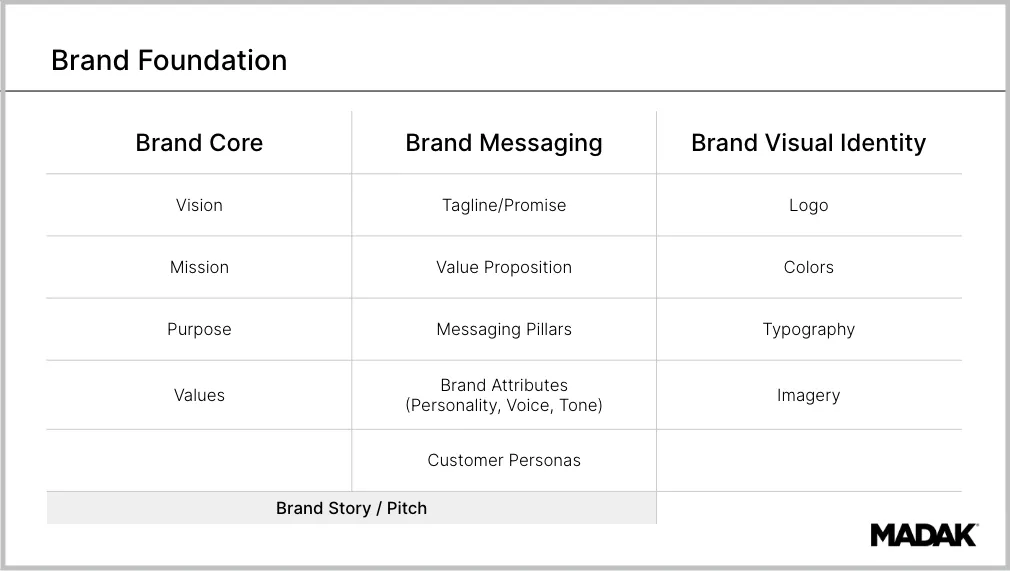
This campaign truly shows the importance of a strong, defined brand foundation, which includes your brand core, messaging, and visual identity. Because Apple had defined who they were, they were able to communicate it in the simplest and most memorable way possible. As Steve Jobs himself said: “Marketing is about values. It’s a complicated and noisy world, and we’re not going to get a chance to get people to remember much about us.”
Apple’s marketing appears simple because of its visual simplicity, which gives most people the false idea that it is easy to accomplish. But it is actually the exact opposite. In order to accomplish simplicity in marketing, you must work to define, align and strategize all aspects of your brand.
Now, we can’t all be Apple, but we can do the work to have an exceptional brand foundation like Apple! Let’s break down the three areas that make up a solid brand foundation:
Brand Core
Your mission, vision, purpose & values are the base of your brand. I always reference the brand core as your “north star.” Everything you create should stem from those. They guide you in everything you do with your brand. A brand core is commonly overlooked, and skipped over to go straight to visual identity. But I have seen over and over again the lack of brand core creates disjointed messaging and non-cohesive visuals. This creates mixed results and confusion on the user/customer side. Examine any successful brand you will find a strong, defined brand core. Take the time to define your brand.
Brand Messaging
Knowing your audience is key to how you communicate your brand. There are lots of ways to say the same thing but you need to identify the simplest and easiest way to communicate what your brand is to your audience. Learn who your audience is. Use as much data as you have to understand them. You want to speak directly to them removing unnecessary barriers. A simple way to think of this is if you knew that the majority of your customer's first language was Spanish, and most of your marketing was in English, then you are just creating an unnecessary barrier for customers to understand who you are. How you talk to your potential customers must be aligned with both your brand core and your audience.
Brand Visual Identity
This is what most people think of when you say branding. A brand's visual identity should be the visual representation of the brand’s core and messaging. This includes your logo, colors, typography, and imagery. This does, however, become one of the most important pieces of your brand because this is what your audience remembers. That is why if it is not aligned with your brand core and messaging, it can become a very confusing disjointed brand experience for a customer, which creates mistrust.
Bring those all together you get a solid brand foundation. They are all important and build on each other, without one the others suffer. When your brand is defined, you are able to ensure that all communication, touchpoints, and marketing are aligned with your brand. The next step is taking a solid brand foundation and creating marketing that appears simple but is actually packed with meaning and intentionality. Stop trying to just look like Apple and start being like Apple.
Read last week's blog about Barbie's Cohesive Brand Experience.
This week's Madak Monday was written by:

Elli Haddick
Senior Marketing Manager
Related Blogs
Lorem ipsum dolor sit amet, consectetur adipiscing elit, sed do eiusmod tempor incididunt ut labore et dolore magna aliqua. Ut enim ad minim veniam, quis nostru.

Tactics: What Is SEO Marketing?
Search engines are undeniably some of the most useful tools of the modern-day, and tens of thousands of searches are conducted every second. In this digital age of business, having an online presence is essential, especially when you’re trying to build brand awareness and market yourself effectively. Thankfully, search engines can help your business thrive if you know how to use them to your advantage! The content you post and your website will be endlessly overlooked unless you make an effort for it to be found—this is where SEO marketing comes in. Keep reading to learn more about what SEO is, why it matters, and how it can help you get more web traffic.

Target Audience: How to Define Your Specific Market
Unless you’re in the business of selling air or water, not everyone is going to be interested in your product or service. Though some may think of this as a disadvantage, having a specific market can actually prove to be helpful since you don’t have to worry about catering to every single person on the planet—only the people that might actually care. Keep reading to learn more about what a target audience is, why it matters, and a few strategies you can use to determine yours.

Design Basics: How to Know When to Rebrand
Though your brand is more than just your business name, logo, and overall design scheme, these aspects are crucial to guiding public perception. If the thoughts and emotions that people experience when thinking about your business are not in line with what you want them to be, it might be time to rebrand. Keep reading to get an understanding of why rebranding is so important for a growing business in an evolving market, and to learn about 6 reasons why you might want to rebrand.
Reimagine Your Digital Impact
Transform your website, pitch decks, sales collateral and more, all with transparent, upfront, pricing.