5 min read
Your Website Talks About Your Company. Does It Explain Your Product?

Share
Most B2B websites are built to answer one question: who are you? Mission, values, team, maybe a client logo wall. What they almost never answer is the question that actually gets deals moving: what do you make, and how does it work?
A dedicated technology or product page explains what your company actually does, using visuals and content together to walk a reader through the mechanics of your offering. Most sites skip this and default to general company messaging, which leaves technical buyers without the specifics they need to trust you or move forward.
The Company Page Isn't the Same Job as the Product Page
I've spent the last year working with a technology company, helping them raise capital and sharpen how they talk about who they are. That work matters. Investors and partners want to know your story, your traction, your team.
But at some point, "who we are" stops being the question. The question becomes "what is this, actually, and how does it work?" That's a different job, and it needs a different page.
Company pages sell trust. Product pages sell understanding. You can't do both jobs on the same page without shortchanging one of them, and most companies end up shortchanging the second.
Why Technical Buyers Bounce Without Ever Learning What You Do
Here's the pattern I see constantly. A visitor lands on a homepage, reads three paragraphs of positioning language, sees a stock photo of people pointing at a laptop, and leaves without knowing what the company's technology actually does.
That's not a design failure. It's a messaging failure. The page was never built to explain the product, so it doesn't, no matter how clean the layout looks.
Technical buyers in particular are looking for specifics: how the system works, what problem it solves at a mechanical level, what makes the approach different from the five other vendors they're evaluating. If your site doesn't give them that, they'll assume you don't have it, even if you do.
Visuals Should Explain, Not Decorate
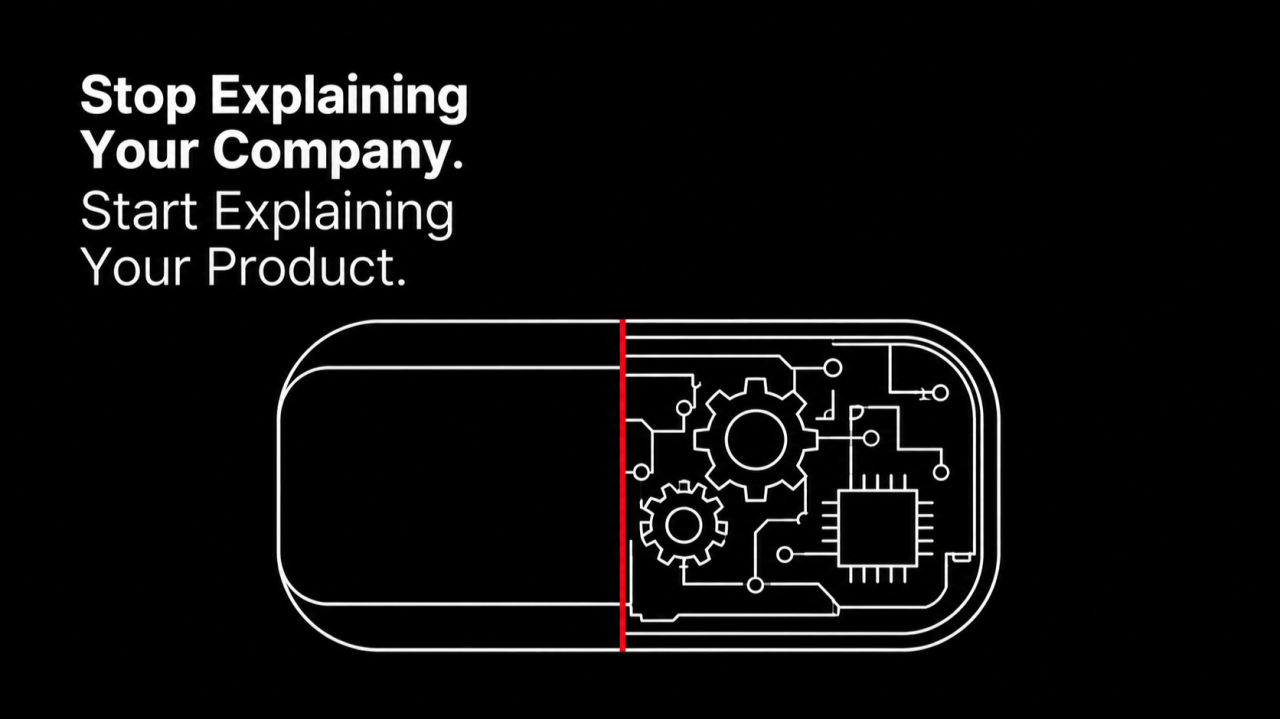
The fix isn't more copy. It's pairing content with visuals that actually do explanatory work instead of filling space.
When we built out a technology page and a product page for that same client, the goal wasn't to write more words about the product. It was to use diagrams, screenshots, and process visuals to show how the technology functions, with copy that walks alongside the visual instead of competing with it.
A good product page reads almost like a guided tour. The visual carries the structure. The copy fills in the why. Neither one is trying to do the other's job, and that's exactly why it works.
What This Actually Requires
Building a page like this takes more than a template. You need someone who understands the technology well enough to know what's worth showing, and a designer who can turn that understanding into a visual sequence a reader can follow without a glossary.
It also takes restraint. The instinct is to explain everything. The better move is to explain the two or three things that actually change how a buyer sees you, and let the rest live in a demo or a conversation with your team.
If you're evaluating this kind of technology yourself and want to see what a page like this looks like in practice, Gemateg has one built. Worth a look at gemateg.com, and their team knows the technology better than almost anyone who could walk you through it.
Frequently Asked Questions
What's the difference between a company page and a product page? A company page answers who you are: mission, team, credibility. A product page answers what you actually do and how it works. Buyers need both, but they need them at different stages, and combining them usually means neither gets done well.
Do I need a separate technology page if I already have a product page? It depends on complexity. If your technology is the differentiator, a dedicated page that goes deeper on mechanics, architecture, or method can give technical buyers what a general product page can't.
Why do visuals matter more here than on other pages? Because you're explaining function, not just features. A diagram or process visual can show how something works in seconds. The same explanation in text alone usually takes several paragraphs and still loses people.
How do I know if my current site has this gap? Ask someone unfamiliar with your company to read your homepage and explain back to you what you actually do. If they can't, in plain language, within thirty seconds, you have the gap.
Is this a copywriting problem or a design problem? Neither, really. It's a strategy problem. You need to decide what the page's job is before you write a word or design a single frame. Once that's clear, the copy and visuals follow.
If your website tells people who you are but leaves them guessing about what you actually do, that's not a small gap. It's usually the reason good-fit buyers quietly leave without ever booking a call. Happy to talk through what a page like this could look like for your company if you want a second set of eyes on it.
Related Blogs
Lorem ipsum dolor sit amet, consectetur adipiscing elit, sed do eiusmod tempor incididunt ut labore et dolore magna aliqua. Ut enim ad minim veniam, quis nostru.

How to Boost Brand Awareness
Brand awareness generally refers to how well customers recognize a specific brand or product based on its name or defining features. In other words, how many people are familiar with your brand and are able to remember it in the right circumstances? Typically, the idea behind growing your brand awareness is to become a more well-known and authoritative figure in your industry. Companies with higher levels of brand awareness usually generate more sales, have more loyal customers, and can introduce new services/products more easily. Boosting brand awareness is essential for any company that wants to grow and secure a position for itself in the market, as most people tend to “buy the name” rather than the product. In fact, 71% of consumers reported that they would like to recognize the name of a brand they purchase from. So, how can you boost your brand awareness? Keep reading to find out.
6 Reasons Why LinkedIn Is Important to Grow Your Business
Many business owners and marketers tend to overlook LinkedIn because it’s not a mega-popular social media platform such as Instagram or TikTok. However, LinkedIn is a very popular professional networking site that has many parallels to “traditional” social media channels. LinkedIn is a semi-casual platform where business professionals can discuss news, talk about jobs, share articles, evaluate new research, and much more. Its main focus revolves around networking and creating relationships based on career similarities and mutual business interests. That being said, LinkedIn grew into something bigger over the years, and nowadays, there are plenty of other benefits to using it for your company’s growth. Keep reading to learn about six reasons why you might want to prioritize LinkedIn in your growth strategy.

5 Tips On Providing Value to Your Customers
If you want to grow your brand, then creating strong ties with your target audience is essential. Gaining the trust and loyalty of your customers is a must for any modern company that wants to develop a solid customer base and continue to grow in its industry. Nurturing brand loyalty is about more than just producing high-quality products and services—it’s also about displaying credibility and sincerity and providing value in a multitude of ways. There are so many ways to offer value to your customers beyond the products and services you offer, and this value can tip the scale in your favor. In this blog, we will be taking a look at five actions you can take to provide great value to your customers. Let’s get started!
Reimagine Your Digital Impact
Transform your website, pitch decks, sales collateral and more, all with transparent, upfront, pricing.