5 min read
Boost Your Sales and Marketing with the Digital Impact™ Framework

Share
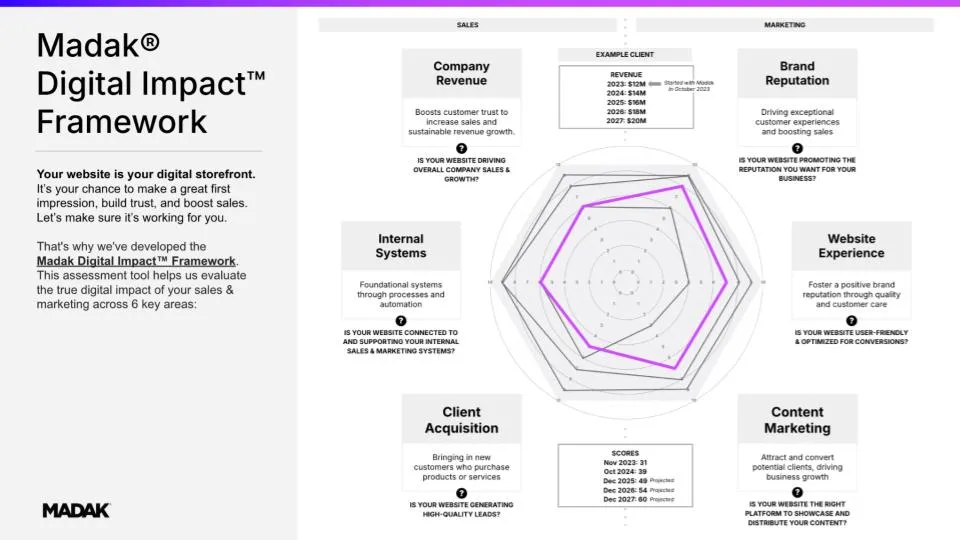
Many businesses face a common challenge—sales and marketing efforts that aren't aligned. When these areas don’t work together, your overall growth can suffer. At Madak, we developed the Digital Impact™ Framework to help businesses bridge that gap, aligning their digital strategy across six essential areas for long-term success.
Let’s break down how this framework can elevate your business.
What is the Digital Impact™ Framework?
The Digital Impact™™ Framework evaluates six critical areas that shape your digital presence and business growth. By focusing on these, we help you identify strengths, gaps, and opportunities for improvement. These areas are split into three marketing components and three sales components.
Marketing Components
- Brand Reputation
Your brand is the face of your business, and it plays a major role in how customers perceive you. We assess whether your digital presence—especially your website—reflects the reputation you want. Does it give customers confidence in your brand, or is there room for improvement? - Website Experience
A great website does more than look good. It should offer a seamless user experience that draws visitors in and guides them to take action. We evaluate if your website provides a smooth, engaging journey that reflects the quality of your business and helps build trust with potential clients. - Content Marketing
Content is one of the most powerful tools for engaging your audience. We look at whether your content is attracting the right audience and converting them into clients. Is it valuable and relevant? Does it support your broader marketing goals?
Sales Components
- Client Acquisition
How effective is your website at bringing in new customers? We analyze whether your online presence is optimized to attract, engage, and convert leads. The goal is to ensure you’re set up for success in acquiring new business. - Internal Systems
Your internal systems need to work together seamlessly to support your sales and marketing efforts. We assess whether your tech tools—from CRMs to email marketing systems—are working efficiently, or if they’re creating bottlenecks that slow your growth. - Company Revenue
Ultimately, your sales and marketing efforts should drive revenue. If they’re not, we help you identify what’s holding you back and work on strategies to improve your financial performance.
Case Study: How the Framework Helped a Client Align and Grow
One of our recent clients was excelling in sales, but their marketing was lagging. Their website didn’t represent the quality of their service, and their content wasn’t effectively generating new leads.
Using the Digital Impact™ Framework, we helped them strengthen their brand reputation, improve their website experience, and implement a targeted content marketing strategy. Within eight months, their client acquisition increased, and their overall revenue saw significant growth. By aligning their sales and marketing efforts, they created a balanced strategy that continues to drive success.
Why Alignment is Crucial
The key takeaway from the Digital Impact™ Framework is that alignment between sales and marketing is essential. These two functions shouldn’t operate in isolation; they need to support each other. When they do, the results are powerful—higher revenue, stronger customer relationships, and sustainable growth.
By assessing your efforts across the six core areas of the Digital Impact™ Framework, you’ll be able to create a more balanced and effective digital strategy. It’s about building a foundation that not only delivers results today but sets you up for long-term success.
Ready to Align Your Sales and Marketing?
If your sales and marketing aren’t fully aligned, you could be missing out on significant growth opportunities. At Madak, we specialize in helping businesses assess and improve their digital strategy using the Digital Impact™ Framework.
Book a discovery meeting with us today, and let’s explore how we can help you create a balanced, cohesive strategy for success.
Related Blogs
Lorem ipsum dolor sit amet, consectetur adipiscing elit, sed do eiusmod tempor incididunt ut labore et dolore magna aliqua. Ut enim ad minim veniam, quis nostru.

8 Tips to Grow Your Email List
Many online publications may try to convince you that email marketing is dead, but as always, you can't believe everything you read online! In fact, to this day, email marketing remains one of the best ways to maximize your business's profit, as the return on investment (ROI) is one of the highest out of all marketing methods (about $36 in return for every $1 spent). Research has shown that almost 100% of consumers check their email on a daily basis. This process occurs on multiple devices: laptops, tablets, work PCs, and of course, mobile phones. Therefore, if your email marketing campaign is well-made and you have a healthy email list, it can significantly benefit your business. Of course, for an email marketing campaign to work, you need to have subscribers, which brings us to the topic of today's article—growing your email list. Below, we will look at eight practical tips to help you get more email subscribers and build your list.

11 TikTok Content Ideas for Businesses
With over one billion users, TikTok can be a useful platform for business owners to promote their products and services if they navigate it correctly. Unfortunately, the sheer amount of content that is posted on TikTok daily can make it difficult for brands to get noticed. Not only is there already pressure to create noticeable and entertaining content, but most TikTok users tend to be turned off by advertisements. Because of this, it’s important that whatever videos you make for your business come across as authentic, personable, and relatable. It can be hard to know where to start, but let’s take a look at some ideas that can help you gain traction and promote your product.

10 Proven Ways to Reduce Your Bounce Rate
Reducing your website’s bounce rate is one of the best things you can do to boost user engagement and site rankings, eventually increasing customer conversions. Many people lack knowledge on what constitutes a good vs. bad bounce rate and how to reduce it. First things first—according to Semrush, “a bounce rate of 56% to 70% is on the high side,” and “an optimal bounce rate would be in the 26% to 40% range.”If your website is struggling to get attention and it’s challenging for you to find leads from web traffic, it might be time to look at what you can do to reduce your bounce rate. Keep reading!
Reimagine Your Digital Impact
Transform your website, pitch decks, sales collateral and more, all with transparent, upfront, pricing.