5 min read
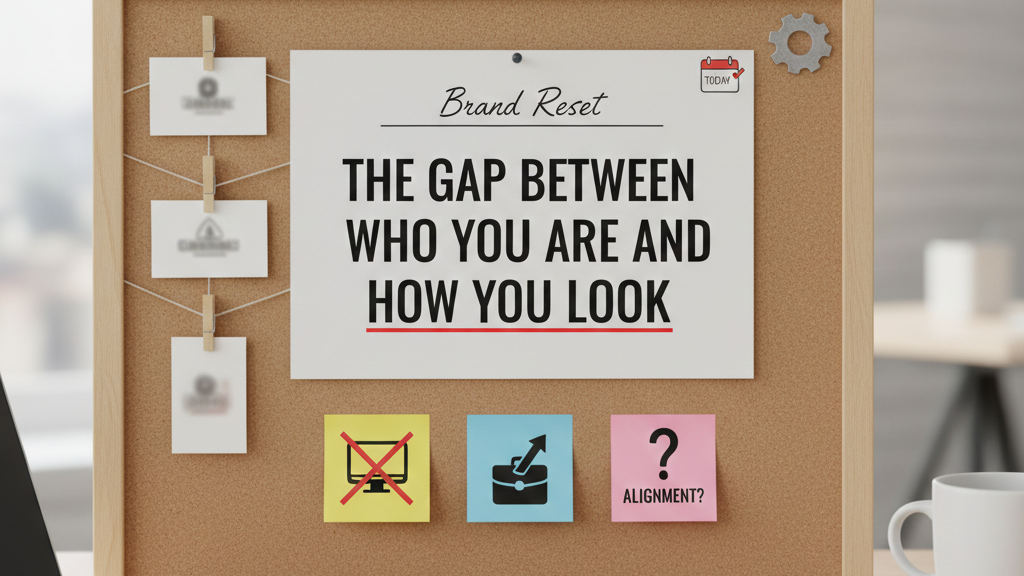
The Gap Between Who You Are and How You Look

Share
As business owners, we are in a constant state of motion. We’re refining our messaging, obsessing over the details of our offers, and pivoting toward bigger goals. Growth is rarely a straight line; it’s a series of evolutions.
But here’s the problem: Your brand is often the last thing to catch up.
It’s a strange, uncomfortable friction. Internally, you know exactly where you’re going. But externally? Your digital presence is stuck in 2022. It happens slowly, then all at once, until you realize there’s a massive gap between the business you run and the brand the world sees.
The Symptoms of an "Outgrown" Brand
You might not feel it every day, but your customers do. When your brand lags behind your actual growth, it creates a "disconnect" that can quietly erode trust. You’ve likely experienced this if:
- The "Website Apology": You find yourself sending links to prospects while saying, "Just ignore the copy on the home page, we’ve changed our focus since then."
- The Sales Friction: Your sales materials feel like they belong to a different company. You spend half your pitch correcting the slides instead of closing the deal.
- The Identity Crisis: You’ve leveled up your service or product, but your visual identity still feels like the "startup" version of you—not the "industry leader" version.
Why Scaling Requires a "Brand Reset"
When you’re just getting started, "good enough" is often exactly what you need to get off the ground. But as you prepare to scale, "good enough" becomes a ceiling.
Scaling isn't just about doing more; it’s about doing it with clarity. If your brand doesn't reflect your current caliber of work, you’re essentially forcing your team to swim upstream. You’re working twice as hard to convince people you’re the right fit because your branding is telling a different story.
Closing the Gap
At Madak, we see this transition every day. We work with brands to bridge that gap—turning that lingering "brand debt" into a foundation of confidence. Whether you’re a founder finally ready to look as professional as you actually are, or a scaling team that needs a cohesive North Star, the goal is the same: Alignment.
Your brand shouldn't be a time capsule of where you used to be. It should be a launchpad for where you’re going.
Related Blogs
Lorem ipsum dolor sit amet, consectetur adipiscing elit, sed do eiusmod tempor incididunt ut labore et dolore magna aliqua. Ut enim ad minim veniam, quis nostru.

10 Proven Ways to Reduce Your Bounce Rate
Reducing your website’s bounce rate is one of the best things you can do to boost user engagement and site rankings, eventually increasing customer conversions. Many people lack knowledge on what constitutes a good vs. bad bounce rate and how to reduce it. First things first—according to Semrush, “a bounce rate of 56% to 70% is on the high side,” and “an optimal bounce rate would be in the 26% to 40% range.”If your website is struggling to get attention and it’s challenging for you to find leads from web traffic, it might be time to look at what you can do to reduce your bounce rate. Keep reading!
9 Call to Action Best Practices
When determining the best marketing strategy for your business, it is essential that you take a close look at your calls to action. The call to action, or CTA, could be considered the most important part of your copy. It is the part that motivates potential customers to take action (buy, sign up, visit a page, etc.) while providing them with the necessary steps for what to do next. For this reason, creating a powerful and memorable CTA for your web copy and sales copy is vital to your company’s overall success. Keep reading to learn more about CTA best practices that will improve your marketing strategy and help you convert leads more effectively.

Landing Pages vs. Websites
The core differences between landing pages and websites can be hard to figure out, especially if you are new to the world of digital marketing. Landing pages and websites play off one another and work together to form a cohesive brand and build trust and interest in your customers and leads. Though there are similarities between landing pages and websites, the two have some important distinctions that boil down to their purpose. Keep reading to learn about some of the differences and similarities between landing pages and websites before you take the plunge and start creating your own (or before your hire someone else to help you)!
Reimagine Your Digital Impact
Transform your website, pitch decks, sales collateral and more, all with transparent, upfront, pricing.