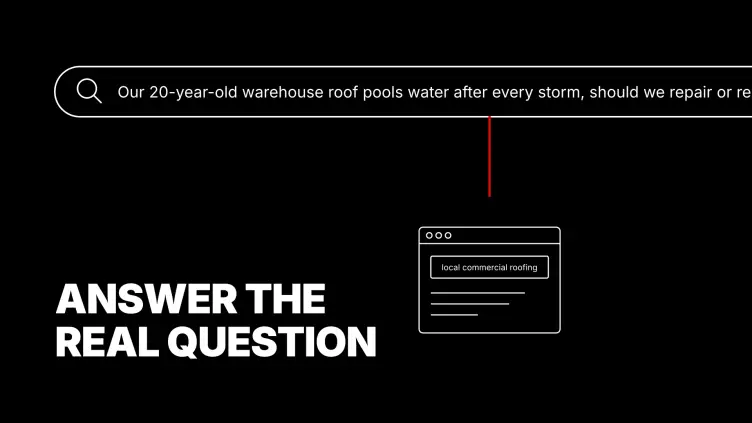
Look at the pages on most owners’ websites that were built for search, and you’ll find they were written around a short phrase like “Local commercial roofing” Your best customers stopped searching that way. They type out their whole situation, including what’s gone wrong and what they need to know before they spend money, and a page built around three words has very little to say back to them. If you want content for Google AI Mode to bring in real leads, it has to start with the question your customer actually brought you.
To show up in Google AI Mode, write pages that answer the full, specific questions your customers ask, in plain language, instead of pages built around short keywords. AI Mode searches are conversational and much longer than traditional ones. The best source for those questions is your sales calls and your inbox, not a keyword tool.
What Is Google AI Mode, and Why Are Searches Getting Longer?
AI Mode is a feature in Google Search where people chat with search the way they’d talk to a person. They type or speak in full sentences, ask follow-ups, and get an answer back. You don’t need to understand how the AI works under the hood to act on what it’s doing to search behavior.
The numbers Google shared recently make the shift hard to ignore. On Alphabet’s Q3 2026 earnings call, Sundar Pichai said year-over-year search query growth was the highest it had been in five years, and that queries in AI Mode are on average three times longer than traditional searches, with one in five AI Mode searches globally using voice, images or documents.
What that tells you is simple enough. People are searching more, and when they use AI Mode, they’re describing their situation in detail. Those long conversational search queries carry a lot of context, and Google is trying to match them with pages that respond to that context.
Why a Short Keyword Page Can’t Answer a Full Question
Picture a facilities manager typing something like this: “Our 20-year-old warehouse has a flat roof that pools water after every storm. Should we repair it before winter or start planning a replacement, and roughly what should we budget?” That person is close to spending real money. They want to feel understood before they pick up the phone.
Now picture the page that’s supposed to catch them. It says the company offers commercial roofing in Seattle, lists a few services, mentions years in business, and ends with a contact form. Every word on it might be accurate, and none of it touches repair versus replacement, ponding water, or budget. AI Mode has nothing on that page to pull into an answer, so it pulls from a site that did the work.
This is the gap most service businesses are sitting in right now. Their pages were written to rank for a phrase, and the people they want are asking about a problem. The page and the prospect are having two different conversations.
What Google Recommends: People-First Content
Google has been consistent on this for years. Its guidance tells site owners to create helpful, reliable, people-first content, meaning content written to serve the person reading it rather than to game a ranking system. That guidance didn’t change when AI Mode arrived. If anything, longer queries make it easier to see why it matters.
In practice, people-first content mostly means answering the real question someone brought to you. Say the answer early, in the words your customer would use. Then give them what they’d want to know next, like what it typically costs, what affects the timeline, and what to watch out for. That’s the material an answer engine can actually use, and it’s what a nervous buyer needs to trust you.
You don’t have to chase every new feature Google announces to get this right. A page that clearly and honestly answers a common customer question was good practice before AI search existed, and it’s more valuable now.
Where the Real Questions Live: Your Sales Calls and Inbox
Keyword tools are useful, but they tend to show you short, aggregated phrases. The long, specific questions your best customers ask almost never appear there in full. They show up in discovery calls, in email threads, in the notes your sales team takes after a meeting, and in the follow-up questions people ask right before they sign.
Your team is probably answering those questions well every week. The problem is that those answers stay in the inbox. When the explanations your salespeople give on calls never make it onto the website, the site ends up working from a different script than your people are, and prospects researching on their own get the thinner version of your expertise.
So the fastest way to build content that answers customer questions on your website is to start collecting them. Ask your sales lead for the five questions they hear most. Search your sent folder for long replies to prospects. Those replies are often a first draft of the page you should already have.
A Test You Can Run This Week
Take the longest question a good customer asked you this month. Write it down exactly as they phrased it. Then go through your site and see whether any page actually answers it, the way you or your salesperson would have answered it on a call.
If the answer is no, you’ve found your next page. Open with a direct answer in a few plain sentences, then cover what that customer needed to know before spending money. Use their language over your industry’s, and keep it focused on that one situation rather than trying to cover every service you offer.
Do that once a month and your site starts to sound like your best salesperson instead of a brochure. That’s a strong position to be in as more searches turn into conversations.
Frequently Asked Questions
What is Google AI Mode? AI Mode is a conversational feature in Google Search. People ask questions in full sentences, often with follow-ups, and Google responds with an AI-generated answer that draws on web pages. Searches in AI Mode tend to be much longer and more detailed than traditional searches.
Do keywords still matter for SEO? Yes, keywords still help Google understand what a page is about. What’s changed is that a short keyword alone rarely captures what a buyer needs. The strongest pages use the language customers search with while actually answering the full question behind it.
How do I find the questions my customers are really asking? Start with your sales team, your inbox, and your call notes. Look for the long, specific questions that come up right before someone decides to buy. Those are rarely visible in keyword tools, and they’re usually the ones your competitors haven’t answered either.
Do I need to rewrite my whole website for AI search? No. Start by adding or improving a few pages that answer your most common high-value questions. One clear, honest page built around a real customer question will usually do more than a site-wide keyword refresh.
How long should a page be to show up in AI Mode? Length isn’t the goal. A page should be long enough to answer the question fully and give the reader what they’d want to know next, and no longer. Put the direct answer near the top so both people and AI tools can find it fast.
Start With One Question
Your customers are already telling you exactly what they want to know. The work is getting those answers out of your inbox and onto your site, where a buyer researching at 10 p.m. can find them. Take the longest question a good customer asked you this month, and if you’d like a second opinion on whether your site answers it, reach out to us at Madak and we’ll take a look with you.